Air Pollution Control
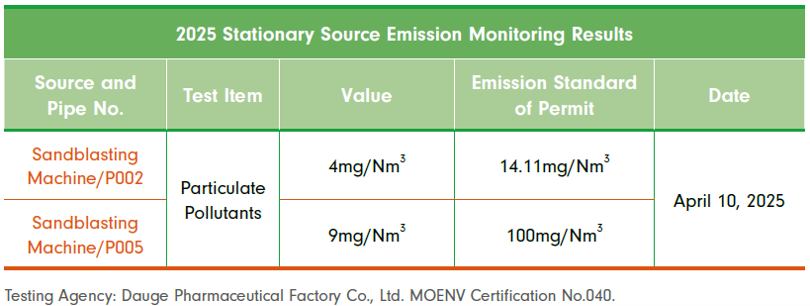
The Taipei Head Office serves as an administrative unit, while the manufacturing processes at the Hsinchu Factory and Kaohsiung Factory do not generate air pollutant emissions and are therefore not subject to regulation by the Ministry of Environment. In 2025, the Xinying Factory implemented air pollution control operations in accordance with the requirements of its fixed pollution source operating permit and completed air pollutant emission testing on April 10, 2025. All testing results complied with the applicable emission standards. The Company conducts annual maintenance of pollution control equipment and regularly replaces filter bags to ensure stable operation. With a target of “Zero Pollution Incidents,” the Company continues to implement pollution prevention measures and maintain compliance with applicable environmental regulations.
Water Pollution Prevention
The Company's main businesses include steel structure production and assembly, and container maintenance and cleaning. The Taipei Head Office serves as the administrative unit, and the steel structure manufacturing at Hsinchu and Xinying factories do not generate industrial wastewater. The wastewater produced during container cleaning processes at Kaohsiung Factory undergoes 16 treatment steps, including sedimentation, rapid mixing, slow mixing, chemical precipitation, equalization, and concentration/dehydration, to meet discharge standards before being discharged to the industrial wastewater treatment plant in the industrial park. The Kaohsiung Factory conducts regular annual maintenance of its treatment equipment and commissions a certified inspection agency to perform water quality testing to ensure that discharged water complies with legal standards and does not negatively impact the environment. The Company will continue to operate in compliance with environmental regulations, maintaining its goal of zero pollution and zero leakage.
.jpg) |
.jpg) |
Waste Management
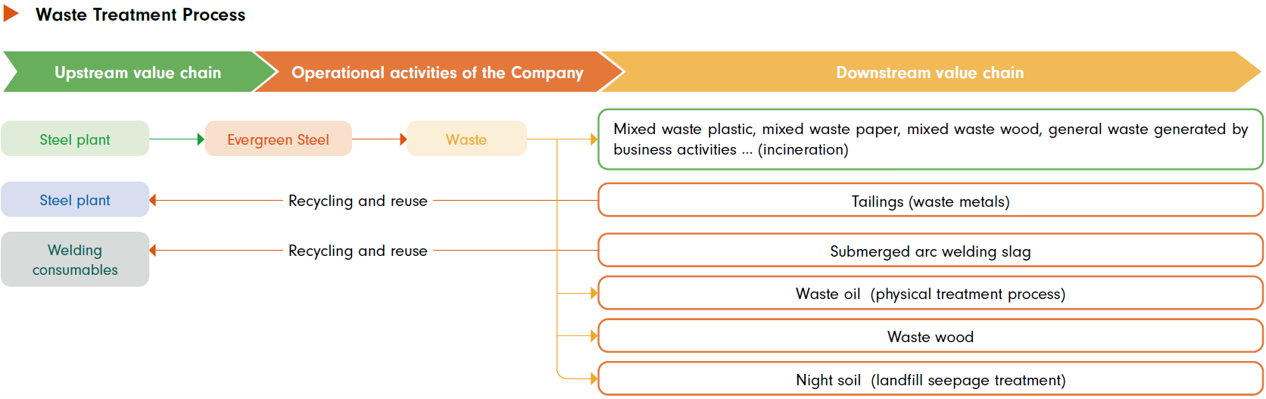
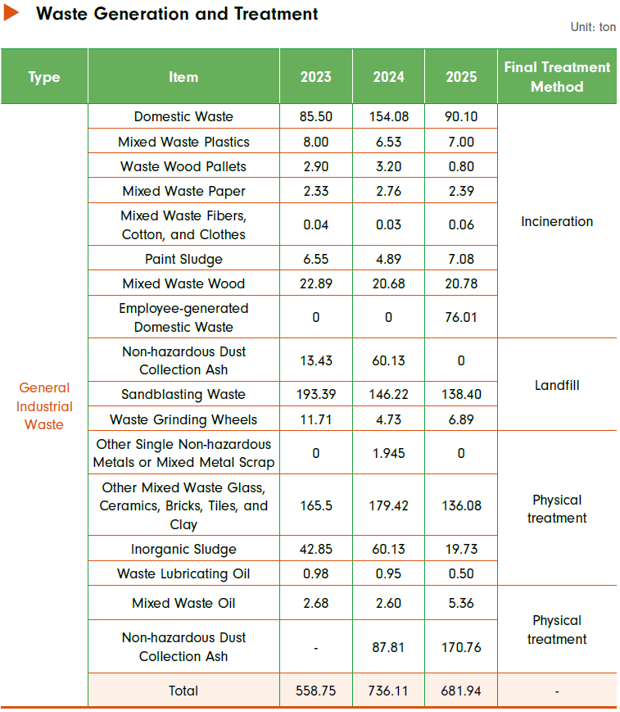
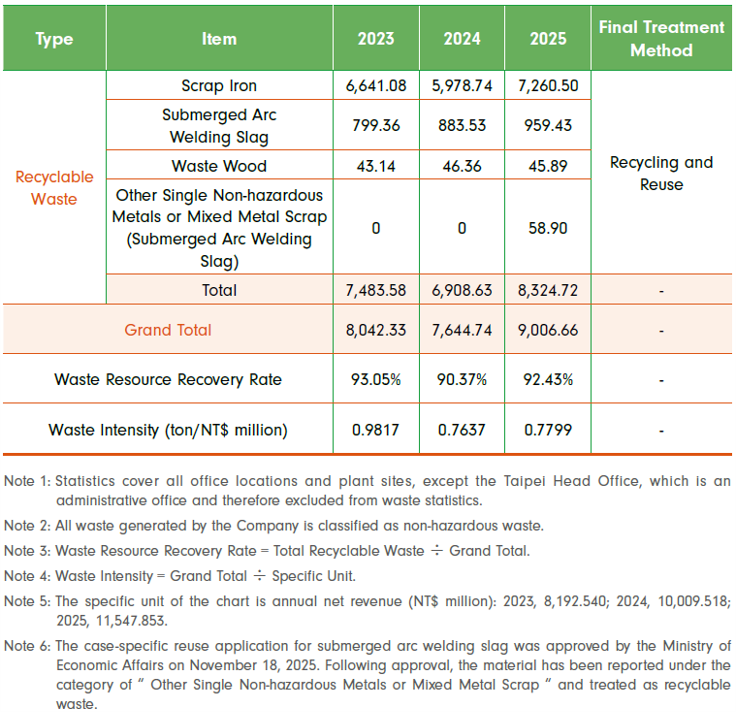
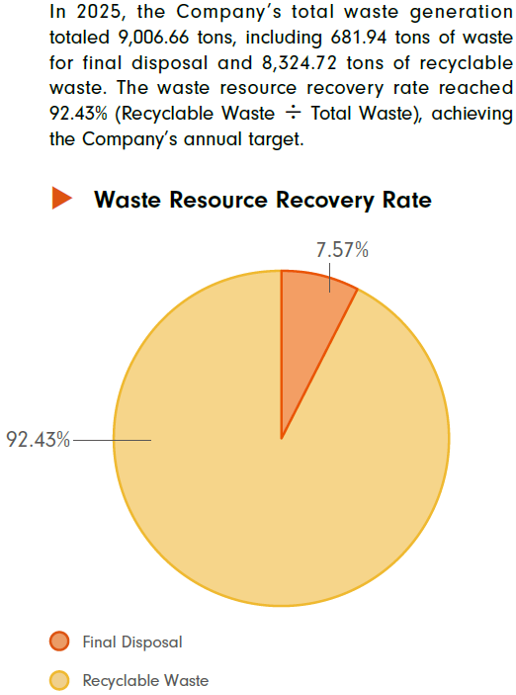
All waste generated by Evergreen Steel is sorted and stored in designated storage areas in accordance with applicable regulations. Based on categories such as mandatory recyclable waste, reusable waste, and industrial waste, the Company signs contracts with qualified waste transporters and commissions licensed recycling, transportation and treatment contractors to conduct waste recycling and disposal operations, ensuring the legality and safety of final treatment. The waste generated by the Company is entirely classified as non-hazardous waste, primarily including domestic waste, inorganic sludge, mixed waste wood, mixed waste plastics, scrap iron, submerged arc welding slag, and septic waste. Recyclable materials, such as inorganic sludge, scrap iron, submerged arc welding slag, and waste wood, are properly sorted and recycled. To enhance resource utilization efficiency and reduce treatment costs, the Company continues to evaluate diversified disposal and recycling approaches for waste reduction and strives to maintain a waste resource recovery rate above 90%, exceeding the Ministry of Environment’s target resource recovery rate of 85%. Waste that cannot be recycled is ultimately treated through incineration, landfill disposal, or other appropriate disposal methods. All waste generated by the Company is treated off-site. Waste (including recyclables) generated at each plant is temporarily stored on-site in accordance with the waste clearance plan. Once a certain quantity is accumulated, qualified contractors approved by the Ministry of Environment are commissioned to conduct waste transportation and treatment operations. Relevant declarations are completed within the specified timeframe, and waste manifest records are retained for three years. In 2025, the Company did not experience any significant waste leakage incidents.
 |
 |
 |
.jpg)